


'Black players kept on coming forward... you can't deny talent' - Brendon Batson on The Three Degrees and overcoming racism

Brendon Batson has credited the black footballers of the 1970s and 80s with helping to change the narrative around racism in the United Kingdom.
Batson was born in Grenada but moved to England as a nine-year-old, where he took an interest in football and signed for Arsenal at 13.
He became the first-ever black player to play for the club in 1972 when he was subbed on against Newcastle United.
This was a landmark moment for a club that is now recognised for its synonymity with black culture.
Batson said: “I recall being quite nervous because it came suddenly.
“I was in the squad [and] then I'm on the bench watching the game.
“Half-time, I'm sitting in the dressing room - suddenly the coach, Don Howe, says to me: ‘OK, get yourself sorted, you’re on’, because Charlie George was unwell, I think he'd been throwing up in the showers.
“So, I was on, and I remember it was a miserable afternoon.
“My name wasn't even on the team sheet; in those days you didn't have the subs on a team sheet. “I remember hearing what I can call the monkey chants, I could hear the n-word.
“Really, I was trying to concentrate on the game, but to be quite honest I don't recall too much of the game now.
“It seemed to go by me in a bit of a blur.
“So, it was exciting in one way, but I suppose you could say quite forgettable in another.”
The racist chanting put a dampener on what should have been a memorable day for the young full-back.
“I'm not sure I anticipated it (the racist chanting).
“It is something, when people have asked me that question, it is something that I grew up with from the time I came to England as a nine-year-old.“So, in a way, I don't think it was anticipation.
“What surprised me, what really got me… a little bit unaware [of] was the volume.
“You know, I'd been playing on parks, pitches, getting abuse from passing crowds or crowds that used to, you know, a few people used to watch us.
“I'd been used to it - people driving, passing cars, shouting names at us, at me.
“But it was the volume, that's what changed.”
Batson reflects on the black players that defined his era
Racial prejudice was widespread in England throughout the 70s and 80s, with far-right groups like the National Front at the precipice.
However, black sportsmen such as Batson gave a glimmer of hope to discriminated ethnic groups.
He said: “You know, I look back on it, of the players, the black players of my era, I've got a great respect for them because we were, sort of, spotted up and down the leagues.
“You think of Viv Anderson at Nottingham Forest but lower down the leagues there were people like Ces Podd and Joe Cooke, names of maybe - unless you are fans of those clubs - [players] that you [or] people don't really recognise.

“So, I've got immense respect for them despite all the discrimination, no support, no support from the football authorities.
“Black players kept on coming forward in ever-increasing numbers, and in the end, you know, you can't deny talent.
“Everybody says you can't deny talent, it's on show.
“Talent is a limited resource, so clubs, whilst they would have sort of whispering campaigns around black players around my time about the ‘lazy, they've got no discipline, they've got no bottle, they don't like the cold’, all those sorts of prejudicial views with no confirmation of that in any way you know.
“You only have to look and see black players playing in all sorts of weathers and parks, but they just kept on coming forward.
“And in the end, talent can’t be denied.
“But it was something that they needed to be very resilient [with]. That's one of the things.
“But it’s something that we grew up with, you know, the football wasn't in isolation. It's something that we've grown up with - particularly around London, where there are lots of black families.
“Generally, you kind of gravitate to each other and that seemed to almost incense certain sections.
“And don't forget, the National Front was on the rise, late 60s, going to the 70s and they used football as a kind of platform that they could voice their spiteful views because of the anonymity of being involved in a big crowd and the football authorities did nothing.”
Becoming the ‘Third Degree’ at West Bromwich Albion

After struggling for game time in North London, the ‘Football Hall of Fame’ inductee moved to Cambridge United where he would spend four years under Ron Atkinson.
In 1978, he - alongside Atkinson - moved to the West Midlands where he would join West Bromwich Albion.
Already at the club were two other prominent black players, Cyrille Regis and Laurie Cunningham.
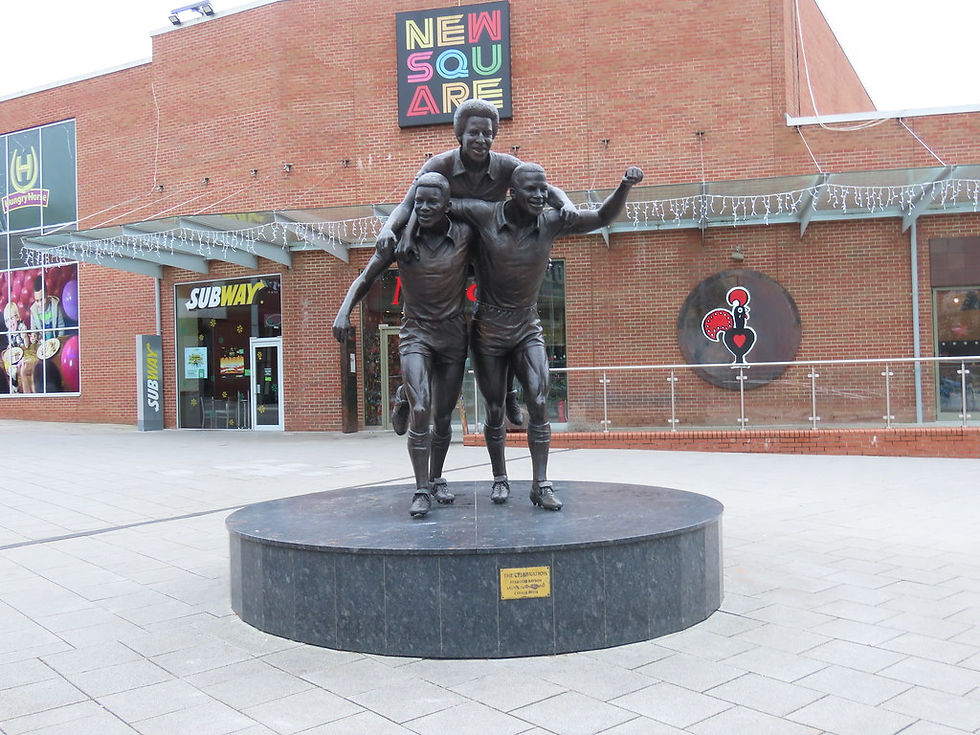
The trio would go on to be dubbed ‘The Three Degrees’ by their manager after the American vocal group of the same name, and they were all pioneering figures of equality in football.
“I think one of the things with that team, because of the three of us, that there's a spotlight on us and on the team, but the team was a very, very good team as well.
“I think if we were playing rubbish football, there wouldn't have been that kind of spotlight on us and that, sort of, positive publicity that we were getting.
“The odd thing about it, I mean, I probably was a bit naive in thinking that because there were three of us playing on a regular basis that would help with the abuse that we were receiving.
“But that seemed to make it worse. It seemed to annoy the crowd even more, that there were three black players playing on a regular basis in the topflight.
“So maybe I was a little bit naive in that, but I don't think we fully understood the sort of social impact we were having because at times you’re in a bit of a bubble as a footballer, you know, it's a long season. Well, even longer now.
“But come the end of the season, you know, you tended to take that time, go away with your family for an extended holiday, hopefully.
“And then before you know it, you're back pre-season training so there wasn't a lot of interaction with the sort of, wider public.”
The development of Kick It Out
Batson was forced to retire aged 29 after a serious knee injury.
He quickly found himself another role within the sport, becoming deputy chief executive of the PFA in 1984 - spending 18 years in the role.
During that period he had a significant involvement in the development of ‘Kick It Out’, a campaign and then organisation developed in the 1990s with the aim of eradicating discrimination in football.
He said: “Well, the idea was from Herman Ouseley, who suddenly passed away, Lord Ouseley now. When I first met him he was plain old Herman Ouseley, then he got knighted, then he got made a member of the Lords.
“[He] sadly passed over Christmas, or maybe before then.
“But it was his brainchild, [and] he sent a researcher to see me in my office in Manchester. I think it was about April ’93.
“She told me his idea and I thought it was, like I said it before, it’s like a light bulb moment, ‘oh crikey, how come I didn't think about that sort of [thing].
“I went across [to] Gordon Taylor's office, across from mine, told him the outline of the idea.
“He said: ‘What do you think?’
“I said: ‘We've got to go with it, Gordon’.
“He said: ‘Right, you run with it’, and that's when we started to develop it.
“Herman Ouseley was a fantastic guy; he wanted to use football as a vehicle to address the issues of racism within society.
“He was CEO of the Commission for Racial Equality, it’s changed its name now - EHRC.
“But it was his brainchild, and we launched it.
“It wasn't just about the black players, it's about the white players as well. It was about the game.
“We launched it at the start of the season, ’93. Maybe a month, or two months, before the Stephen Lawrence tragedy.
“And we had a slogan, which I still think is the best slogan we ever had - the first one, ‘it's only the colour of the shirt that counts’.
“So, we use the different shirts, on the platform when we launched it, there were white players, as well as black players there.”
Several successful campaigns have been overseen by the organisation since 1993, but the 72-year-old believes that more action needs to be taken to address discrimination in football.

He continued: “It has been going since ’93.
“I do think it needs a bit more oxygen to get out of there because I think it's losing its impact and it has been for a number of years.
“I think it needs for the players to do more. I would love to see something like ambassadors for Kick It Out.
“Former players being more involved, particularly when there are incidents and the press want to come and talk about it and I'm not being disrespectful to the people who are in charge of Kick It Out at the moment.
“But, you know, you have a former player or current player expressing views the press would eat it up.
“I think, at the moment, it's losing its impact. It's losing ground and I think it needs a shake up really.”
You can watch the full interview with Brendon Batson below:


Comments